




A Brief Guide to Modern Prosthetics
Since the dawn of recorded history, humans and other animals have overcome injuries which permanently alter the body by fashioning artificial replacements for lost parts. Archeologists have found artificial leather toes on Egyptian mummies dating between 950 – 710 BCE. Peg legs and glass eyes are so common in classic genre fiction that they’ve become clichés. There’s nothing new and certainly out of the ordinary about artificial or prosthetic body parts. However, modern advancements in the field have taken us far beyond the realms of previously imagined prosthetic medicine. As part of our ongoing “Spring Into Relief” series, we’d like to appraise our clients who have suffered an injury which may lead to amputation of a limb of their options. We hope this brief guide to modern prosthetics can educate the curious and help the injured face their decision from an educated standpoint.

Will a Prosthetic Limb Be Right For You?
Not all amputation injuries necessarily mean a prosthetic limb will be the best possible solution. Collaboration and communication between doctor and a patient is essential to treating and managing any severe injury or illness. Before choosing a prosthetic limb, you might wish to ask your doctor the following questions:
- Does the remaining bone have enough soft tissue to cushion it?
- To what extent are you in pain?
- What is the state of the limb’s remaining skin?
- What is the residual limb’s range of motion?
- Is the other limb in good condition?
- How active were you before to the amputation?
- What mobility objectives do you have?
- The kind of amputation (above or below the knee/elbow)
The Major Types of Modern Prosthetics
Passive (Cosmetic) Prostheses
Passive prostheses are the simplest type of artificial limb. They are designed primarily to restore the appearance of a missing limb and provide basic support rather than active movement.
Capabilities
- Lightweight and comfortable to wear
- Can assist with stabilizing objects or balance
- Often closely resemble a natural limb in appearance
- Require little maintenance
Drawbacks
- No active movement or grip capability
- Limited functional use for complex tasks
- Primarily aesthetic rather than mechanical
These are commonly used for partial hand or finger loss, or by individuals who prioritize comfort and appearance over functionality.

Body-Powered Prostheses
Body-powered prosthetic limbs use cables and harness systems connected to the user’s body movements. For example, shoulder or chest movements can open and close a prosthetic hand or hook.
Capabilities
- Durable and mechanically reliable
- Provide natural feedback through the harness system
- Lightweight and relatively inexpensive
- Good for physically demanding tasks
Drawbacks
- Limited range of motion compared to electronic devices
- Harness systems can be uncomfortable or restrictive
- Less natural-looking movement
- Requires significant physical effort to operate
These prostheses are commonly used for upper limbs and are valued for reliability and simplicity.
Myoelectric (Electrically Powered) Prostheses
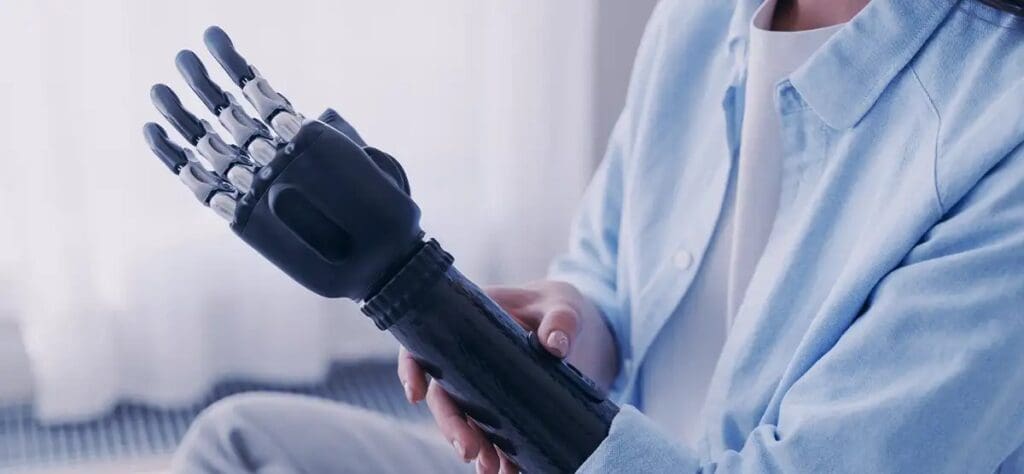
Myoelectric prostheses are controlled by electrical signals generated by the user’s muscles. Sensors detect muscle contractions and convert them into motorized movements of the prosthetic limb.
Capabilities
- More natural-looking movement and grip patterns
- Stronger and more precise hand function
- No harness required
- Multi-articulating fingers and complex movements possible
Drawbacks
- More expensive than mechanical systems
- Heavier and require battery charging
- Sensitive to moisture and environmental conditions
- Require training and maintenance
These devices are often considered “bionic” limbs and are widely used for upper limb prosthetics because they allow more intuitive control.
Hybrid Prostheses
Hybrid prosthetic systems combine elements of body-powered and myoelectric devices. For example, a prosthetic elbow may be controlled mechanically while the hand is electrically powered.
Capabilities
- Combines strength and feedback of body-powered systems
- Allows more precise hand control through electronics
- Useful for higher-level amputations such as above-elbow
Drawbacks
- More complex to operate
- Heavier and more expensive
- Requires specialized fitting and training
Hybrid systems are designed to balance functionality with reliability.
Advanced Lower-Limb Prostheses (Microprocessor and Powered Systems)
Modern prosthetic legs often include computer-controlled knees or ankles. Microprocessors analyze walking patterns and automatically adjust the joint’s movement. These systems can help users walk more naturally and safely.
Capabilities
- Improved balance and stability
- Adaptive walking on stairs, slopes, or uneven terrain
- Reduced risk of stumbling or falling
- More natural gait patterns
Drawbacks
- Very expensive compared to mechanical prosthetics
- Require charging and regular maintenance
- Heavier and technologically complex
These advanced devices are particularly beneficial for active users who want improved mobility.

How Malloy Law Can Help
If you or a loved one has suffered an amputation injury, Malloy Law can help. Our experienced personal injury attorney team will fight for the compensation and support you need to live your life in the wake of a life altering injury. Our dedicated staff is standing by to hear your case free of charge twenty four hours a day. Contact Malloy Law and let’s win your case.