



Are You Aware of Distracted Driving Risks?
April is National Distracted Driving Awareness Month, and it’s never been a more urgent topic. Modern cars are loaded with potential distractions, smartphone-synergy software, infotainment suites, screens, speakers, bells and whistles. These modern conveniences encroach on more of the driving experience with each passing year, and presage, in the opinion of some tech visionaries, a future of self-driving transportation. While inventions like GPS and smartphones can make navigation of our roads and highways far easier, they can also take our attention away from the actual mechanics of driving at crucial moments, sometimes leading to disaster. This week’s Malloy Law blog post will cover distracted driving risks that arise from phone and screen use behind the wheel.
Distracted Driving Statistics
In 2024, 3,208 Americans were killed as a consequence of distracted driving. According to the National Highway Traffic Safety Administration (NHTSA), a further 315,167 people were injured as a result of this risky, irresponsible, yet all-too-common practice.
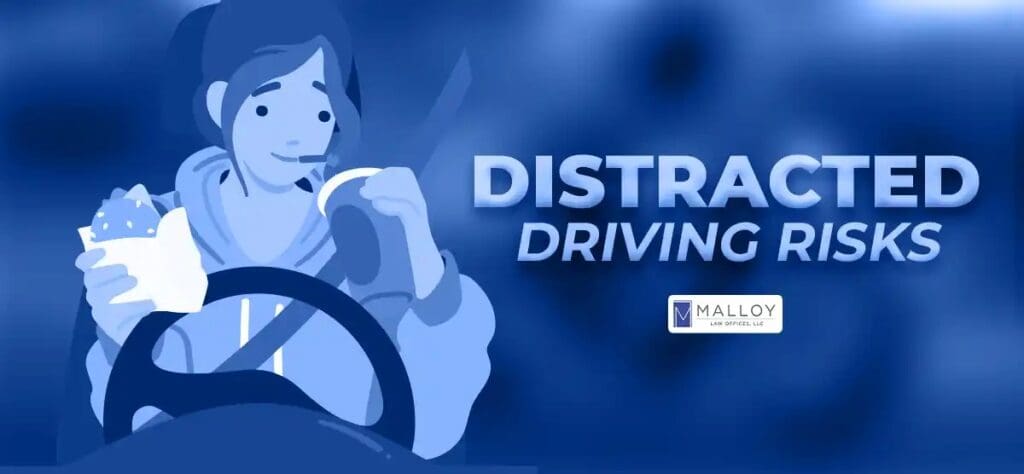
In defining the practice, NHTSA counts “any activity that diverts attention from driving” as distracted driving risks. These include but are not limited to:
- Talking or texting on your phone
- Eating and drinking
- Talking to people in your vehicle
- Adjusting the stereo, entertainment or navigation system
While not the sole culprit, texting and driving is especially notorious in distracted driving prevention circles. Say your eyes leave the road for five seconds while reading a text. If your vehicle is traveling at fifty-five miles per hour, you’ve traveled roughly the length of a football field in those five seconds.

The Personal Injury Implications of Distracted Driving Risks
When building a robust personal injury case in the wake of a car accident, it is absolutely imperative to demonstrate how the accident was caused by the other driver’s negligence. It was their fault. Negligence can be understood as a failure to exercise a minimum of care and responsibility for the safety of others. It has been successfully argued in legal proceedings that drivers using their phones at the time of an accident or immediately beforehand were behaving negligently. Therefore, if your accident occurred while texting and driving, it’s safe to assume that this fact will prove to be a serious impediment to your personal injury case.
This is particularly important in states like Maryland that have contributory negligence laws, which prohibit you from receiving any compensation for injuries, lost wages, destroyed property, or psychological distress if you can be perceived as even somewhat responsible for the accident.

A Structural Issue?
It’s not melodramatic or alarmist to suggest that for some people, the compulsory nature of their phone use mirrors chemical or psychological addiction. An increasing volume of academic literature concludes that phone addiction is rampant among the American public.
While we cannot say this for certain, it does not seem far fetched that these compulsory behaviors would be reinforced by the increasing size and centrality of screens in designing modern cars. Software packages like Apple Car Play and Android Auto link the functionality of our phones directly to our cars, thus associating the use of one’s phone with the act of driving. It’s unfortunate that, in the face of millions spent each year on prevention and awareness about car accidents caused by phone use behind the wheel, auto manufacturers are making it that much harder to keep our streets safe from this irresponsibility.
However, the changing tastes of the car buying public may soon see a return to more analogue-type dashboards. Many luxury cars now boast screens which can be stowed away while in transit, thus reducing the temptation to text or scroll while driving.

How Malloy Law Can Help
If you or a loved one has been injured by a distracted driver, Malloy Law is here to help. Our experienced and diverse team of attorneys can boast the DMV’s car accident specialists. We’ll pursue maximum compensation for your lost wages, medical bills, and pain and suffering. Don’t wait. Contact Malloy Law today and let’s win your case.